
 Send Email
 Whatsapp


Introduction
Solar Connectors may be small, but in modern PV systems they carry high-voltage DC power through decades of heat, cold, UV exposure, moisture, salt, and chemical contamination. Their durability directly affects safety, energy yield, and long-term maintenance costs, especially in utility-scale and commercial installations where one weak connection can compromise an entire string. This article examines the environmental stresses solar connectors face, the material and sealing strategies that help them resist aging and corrosion, and the failure modes that appear when those protections fall short, providing a practical foundation for evaluating connector reliability in demanding field conditions.
Why Solar Connector Durability Matters
Solar connectors serve as the critical linkage points in utility-scale and commercial photovoltaic (PV) arrays, tasked with safely transmitting power over decades of continuous operation. As industry system voltages have increased to 1500V DC to maximize transmission efficiency, the demands placed on these small components have grown exponentially. A single compromised connection can jeopardize the energy yield of an entire string, making structural and environmental durability an absolute necessity rather than an optional enhancement.
Effects of harsh environments on connector reliability
Photovoltaic systems operate in some of the most unforgiving climates globally, exposing infrastructure to continuous environmental stress. Sourcing durable solar connectors environmental solutions is paramount, as components must endure daily thermal cycling across ambient temperatures ranging from -40°C to +85°C. Over a standard 25-year project lifespan, this constant expansion and contraction can severely fatigue mechanical seals and metal contacts.
Beyond temperature fluctuations, high levels of ultraviolet (UV) radiation steadily degrade inferior polymer housings, leading to embrittlement and micro-cracking. Coastal, agricultural, or floating PV installations introduce additional chemical threats, notably salt mist and high ammonia concentrations, which accelerate galvanic corrosion if internal conductive components are inadequately sealed against moisture and gas ingress.
Common failure modes and operational risks
When environmental defenses fail, the operational risks escalate rapidly. The most frequent failure mode involves a gradual increase in contact resistance. If moisture bypasses compromised O-rings, oxidation forms on the internal metal pins, driving contact resistance well above the standard 0.5 mΩ safety threshold. This resistance generates localized heat, creating a destructive thermal feedback loop.
Ultimately, severe degradation manifests as thermal runaway, micro-arcing, or the complete melting of the connector's polymer housing. Industry field data indicates that faulty, degraded, or improperly mated DC connectors are responsible for over 70% of reported PV system fires. This statistic highlights the severe safety liabilities and significant revenue losses associated with overlooking environmental resilience during the procurement phase.
What Determines Solar Connector Durability
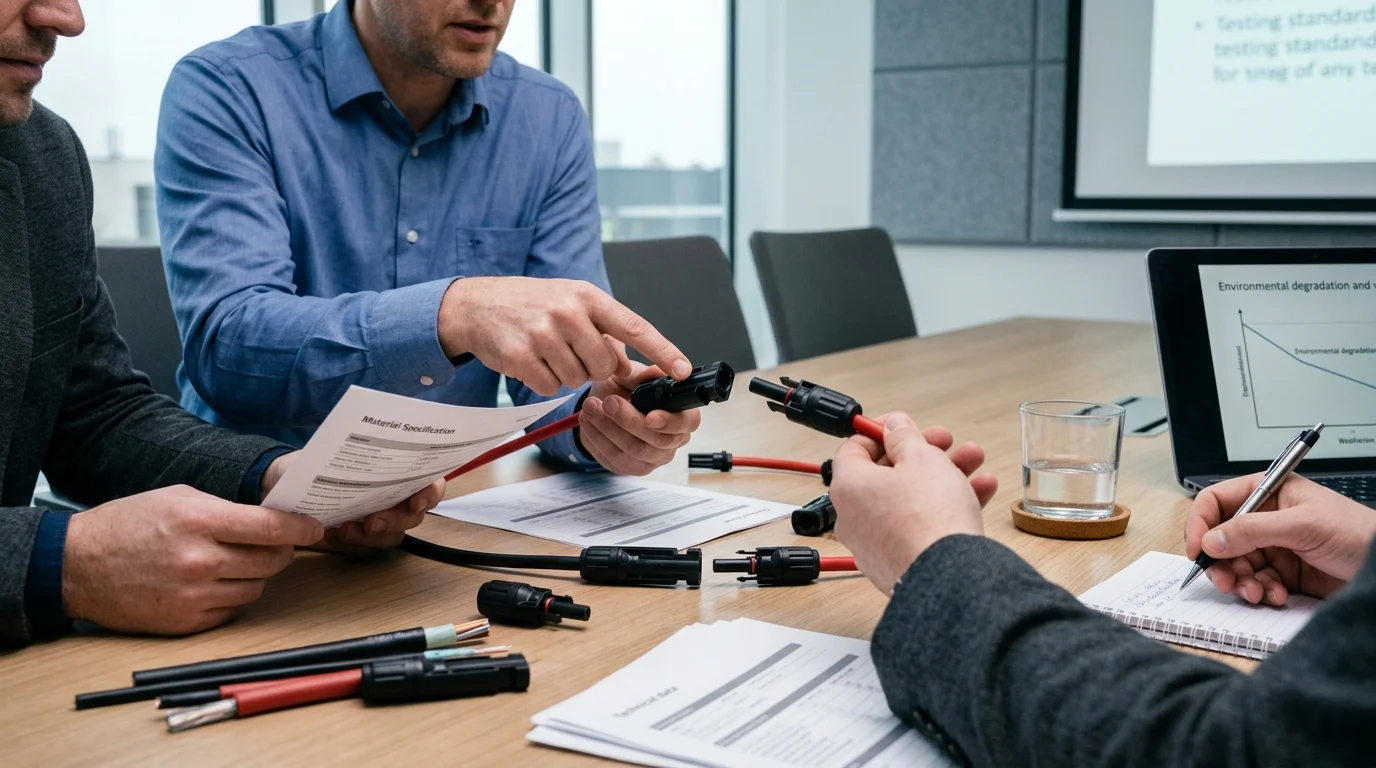
The resilience of a PV connection point is dictated by stringent material science and precision engineering. Manufacturers must balance electrical conductivity with mechanical robustness to ensure components survive decades of relentless exposure without degrading the system's overall power output or safety profile.
Key design, material, and certification factors
Premium connector housings are typically injection-molded from Polyphenylene Ether (PPE) or Polycarbonate (PC) blends. These specialized plastics offer superior UV resistance and achieve high flammability ratings, most notably the UL94 V-0 standard. Internally, the conductive pins are forged from high-purity copper alloys and coated with dense tin or silver plating to prevent oxidation and ensure long-term, low-loss conductivity.
Certifications act as the objective baseline for evaluating durability. Components must meet rigorous international standards, primarily IEC 62852 and UL 6703. These protocols subject connectors to accelerated aging tests, such as damp heat conditioning (typically 85°C at 85% relative humidity for 1,000 hours) and intense UV exposure, verifying that mechanical strength and dielectric insulation resistance remain intact under extreme duress.
How to compare specifications, materials, and sealing
When evaluating technical specifications, procurement teams must look beyond baseline compliance. High-tier connectors feature advanced silicone O-rings and locking nut designs to maintain true IP68 ingress protection, ensuring they remain watertight even when submerged at 1-meter depths for 24 hours.
| Feature | Standard Connector | High-Durability Connector |
|---|---|---|
| Housing Material | Basic PA/Nylon | Premium PPE/PPO Blend |
| Ingress Protection | IP67 (Splash/Rain) | IP68 (Submersion rated) |
| Contact Resistance | < 0.5 mΩ | < 0.2 mΩ |
| Operating Temp Range | -40°C to +70°C | -40°C to +90°C |
| Salt Mist Certification | Optional | IEC 61701 Level 6 |
Comparing these metrics ensures that buyers select materials appropriately matched to their site's specific environmental profile. Specifying lower contact resistance and superior ingress protection prevents premature component replacements and minimizes the long-term levelized cost of energy (LCOE).
How to Verify Connector Durability in Practice
Even the most robustly engineered components will fail if they are improperly deployed or sourced from inconsistent manufacturing lines. Ensuring long-term durability requires rigorous oversight during the field installation phase and a systematic, data-driven approach to vendor qualification.
Inspection, testing, installation, and maintenance checks
Field durability heavily relies on precise installation practices. Installers must use manufacturer-calibrated crimping tools to ensure the cable-to-pin connection meets the required pull-force thresholds, which standard guidelines dictate must exceed 310N for a standard 4mm² PV cable. Improper crimping leaves microscopic voids where moisture can accumulate, rapidly accelerating internal wire corrosion.
Additionally, technicians must adhere to exact torque specifications for the connector's cable gland—usually between 2.5 Nm and 3.0 Nm. Over-tightening can crack the plastic housing, while under-tightening fails to engage the IP68 seal correctly. A critical maintenance check also involves verifying that cross-mating (connecting plugs from different manufacturers) has not occurred. Cross-mating automatically voids regulatory certifications and can increase contact resistance by up to 300% due to microscopic dimensional mismatches.
Supplier evaluation and buying criteria
When qualifying suppliers for large-scale deployments, buyers must scrutinize the manufacturer's quality control infrastructure. Evaluating a supplier involves reviewing their historical defect rates, which should ideally sit below 50 parts per million (PPM) for critical DC components to ensure batch-to-batch consistency.
Procurement teams should also assess supply chain flexibility, noting that minimum order quantities (MOQs) typically range from 1,000 to 5,000 units for direct factory orders. Buyers must demand comprehensive third-party batch testing reports before accepting delivery. Finally, securing a minimum 10-to-15-year product warranty directly from the manufacturer guarantees that the specified durability metrics will be supported by actionable financial protection throughout the project's most critical operational phase.
Key Takeaways
- The most important conclusions and rationale for Ensuring Durability: How Solar Connectors Withstand Harsh Environmental Conditions
- Specs, compliance, and risk checks worth validating before you commit
- Practical next steps and caveats readers can apply immediately
Frequently Asked Questions
Why is connector durability so important in PV systems?
A degraded connector can raise contact resistance, create heat, and reduce string output. In severe cases, poor or damaged DC connectors can trigger arcing, melting, or fire risks.
Which environmental conditions damage solar connectors most?
The main threats are thermal cycling, UV exposure, moisture ingress, salt mist, and ammonia. These can crack housings, weaken seals, and corrode metal contacts over time.
What specifications should buyers check first?
Prioritize IEC 62852 or UL 6703 compliance, IP68 sealing, low contact resistance, UV-resistant PPE/PC housing, and a wide operating range such as -40°C to +90°C.
How can I tell if a connector is suitable for coastal or agricultural sites?
Check for strong sealing plus corrosion resistance. For harsh sites, choose connectors with IP68 protection, tin- or silver-plated copper contacts, and salt mist certification like IEC 61701 Level 6.
How can installers help connectors last longer?
Use only properly matched connectors, ensure full mating and lock engagement, avoid damaged seals, and inspect for moisture or overheating during maintenance. Poor installation can defeat even high-grade designs.