
 Send Email
 Whatsapp


Introduction
Choosing a Photovoltaic Cable supplier affects far more than procurement cost: it determines long-term safety, system efficiency, and compliance under harsh outdoor conditions. Counterfeit or misrepresented products can hide behind convincing labels while falling short on conductor quality, insulation performance, and certification requirements. This article explains how to distinguish authentic photovoltaic cable manufacturers from risky vendors by checking manufacturing credentials, product markings, testing standards, traceability, and supply-chain transparency. By the end, you will have a practical framework for evaluating suppliers and reducing the chance of costly failures, warranty disputes, and fire-related hazards in solar installations.
Why Authentic Photovoltaic Cable Manufacturers Matter
The integrity of any solar energy system relies heavily on the quality of its electrical connections. As the renewable energy sector expands globally, the market has seen a dangerous influx of substandard components. Identifying reliable production partners is not merely a compliance exercise; it is a critical safeguard against catastrophic system failures and severe financial losses.
Photovoltaic systems operate under extreme environmental conditions, facing constant exposure to ultraviolet radiation, temperature fluctuations, and moisture. Components must meet exact specifications to endure these elements over decades. Sourcing from unverified entities introduces unpredictable variables that can compromise an entire megawatt-scale installation.
Project risks and quality impact
Project risks and quality impact stem directly from the electrical and physical limitations of counterfeit cables. Solar arrays frequently operate at high direct current (DC) voltages, often reaching up to 1500V in modern utility-scale installations. When substandard cables are deployed, the compromised insulation and inferior conductors generate excessive heat, drastically increasing the risk of arc faults and devastating electrical fires.
Furthermore, poor-quality cables lead to significant power attenuation. Over a projected operational lifespan of 25 to 30 years, an increase in cable resistance can result in cumulative energy losses amounting to thousands of kilowatt-hours per string. This degradation directly impacts the return on investment (ROI) models that developers and investors rely upon.
Cable types and counterfeit warning signs
Understanding standard cable types, such as the widely specified H1Z2Z2-K and PV1-F variants, is essential for spotting deviations. Authentic cables utilize electron-beam cross-linked polyolefin (XLPO) insulation, which provides exceptional thermal and chemical resistance. In contrast, counterfeiters often substitute this with standard polyvinyl chloride (PVC) or low-grade polyethylene, which degrades rapidly under continuous UV exposure.
Counterfeit warning signs often manifest in the conductor material. Authentic variants use tightly stranded, pure tinned copper to prevent oxidation and ensure optimal conductivity. A common counterfeit tactic is substituting this with copper-clad aluminum (CCA) or utilizing undersized copper strands. For instance, a genuine 6 mm² PV Cable should exhibit a conductor resistance of no more than 3.39 ohms per kilometer at 20 degrees Celsius. If resistance testing yields higher figures, or if the cable feels unusually light or stiff, it is a strong indicator of fraudulent manufacturing.
How to Verify Authentic Photovoltaic Cable Manufacturers
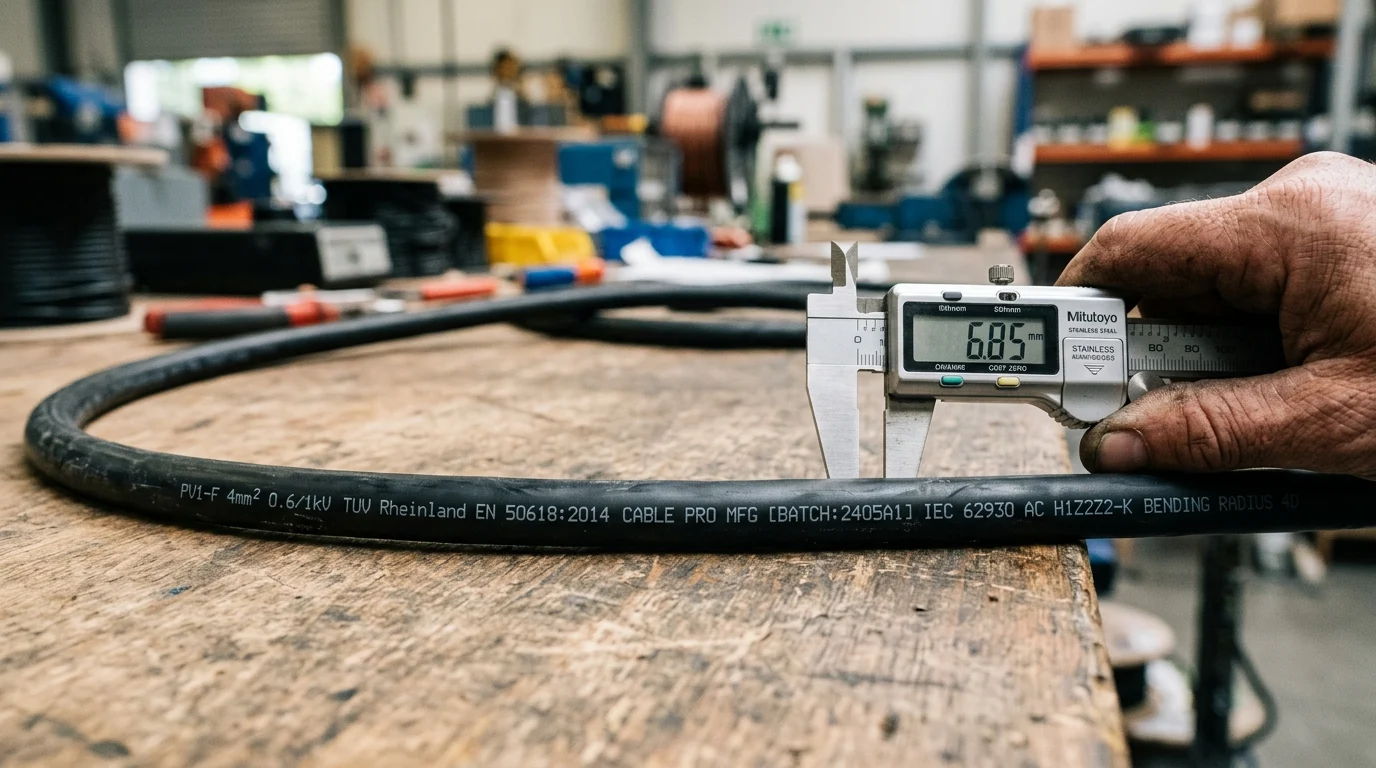
Establishing the legitimacy of a supplier requires moving beyond marketing brochures and conducting rigorous technical due diligence. Industry professionals must implement standardized verification protocols to separate established, authentic photovoltaic cable manufacturers from opportunistic trading companies and fraudulent operations.
Effective verification encompasses a thorough examination of documentary evidence alongside direct assessments of a facility's manufacturing capabilities. This dual-layered approach ensures that the supplier not only understands international standards but possesses the physical infrastructure required to meet them consistently.
Certifications, test reports, and material controls
Certifications and test reports form the baseline of manufacturer verification. Legitimate producers will hold current, verifiable certifications such as TÜV Rheinland (for EN 50618 compliance) or Underwriters Laboratories (for UL 4703 compliance). Procurement officers must independently verify these certificates through the respective issuing body's online database, as digitally altered documents are a common deceptive practice in the industry.
Material controls are equally critical during the verification phase. Buyers should request comprehensive documentation regarding the supplier's raw material supply chain. Authentic manufacturers enforce strict incoming quality control (IQC), requiring certificates of analysis demonstrating 99.9% purity for their copper stock and precise chemical composition data for XLPO compounds. Furthermore, insulation thickness must strictly adhere to standard tolerances, typically requiring a minimum thickness of 0.5 mm to 0.7 mm depending on the specific cross-sectional area of the cable.
Supplier comparison and factory checks
Comparing suppliers through a structured matrix helps highlight discrepancies between genuine manufacturers and counterfeiters. Facility audits, whether conducted virtually or in-person, provide undeniable proof of capability. Auditors should look for dedicated extrusion lines, electron-beam irradiation accelerators (crucial for true cross-linking), and comprehensive in-house testing laboratories equipped with aging ovens, cold bend testing apparatus, and high-voltage spark testers.
| Feature / Specification | Authentic Manufacturer | Counterfeit Supplier |
|---|---|---|
| Conductor Material | 99.9% Tinned Copper | Copper-Clad Aluminum (CCA) or Brass |
| Insulation Compound | E-beam Cross-linked Polyolefin (XLPO) | Standard PVC or untreated Polyethylene |
| Expected Lifespan | 25+ Years | 3 to 5 Years (rapid UV degradation) |
| Operating Temp Range | -40°C to +120°C | -10°C to +70°C |
| Certification Status | Verifiable via TÜV/UL databases | Photoshopped or expired documents |
By systematically evaluating suppliers against these benchmarks, project managers can efficiently filter out high-risk entities. A factory check that reveals a lack of specialized irradiation equipment is a definitive sign that the facility cannot produce compliant XLPO solar cables.
Procurement Steps for Selecting Authentic Photovoltaic Cable Manufacture
Executing a secure procurement strategy requires a disciplined, multi-stage approach. By treating supplier selection as a structured funnel, procurement teams can systematically eliminate non-compliant vendors while building long-term relationships with capable manufacturing partners.
This process relies heavily on empirical data, strict auditing frameworks, and legally binding quality agreements to ensure that the initial sample quality matches the continuous mass production output.
Sourcing and audit steps to reduce risk
The sourcing phase should begin with a broad market scan, filtering candidates by their adherence to Quality Management Systems such as ISO 9001:2015. Initial audits must demand transparency regarding production capacity and lead times. A critical metric to evaluate is the Minimum Order Quantity (MOQ). Authentic manufacturers typically require an MOQ of 5,000 to 10,000 meters for custom production runs due to the scale of industrial extrusion and irradiation processes. Suppliers offering suspiciously low MOQs for "custom" cables are often sourcing off-the-shelf, non-compliant inventory.
Subsequent audit steps involve requesting physical samples for independent laboratory testing.
Key Takeaways
- The most important conclusions and rationale for authentic photovoltaic cable manufacturers
- Specs, compliance, and risk checks worth validating before you commit
- Practical next steps and caveats readers can apply immediately
Frequently Asked Questions
Why do authentic photovoltaic cable manufacturers matter?
They reduce fire, arc-fault, and energy-loss risks. Genuine PV cables keep insulation, conductivity, and weather resistance stable for 25–30 years.
Which certifications should a real PV cable manufacturer have?
Look for current TÜV Rheinland certification for EN 50618 or UL certification for UL 4703. Always verify certificate numbers in the issuer’s online database.
How can I spot counterfeit photovoltaic cables quickly?
Check for unclear printing, unusually light weight, stiffness, missing traceability, and poor test documents. Counterfeit cables often use PVC or copper-clad aluminum instead of XLPO and tinned copper.
What factory checks help confirm a manufacturer is genuine?
Ask for a factory audit. A real manufacturer should show extrusion lines, electron-beam irradiation capability, IQC records, and in-house tests like spark, aging, and cold-bend testing.
What technical values should I verify before buying PV cables?
Confirm cable type, conductor material, insulation thickness, and resistance. For example, a genuine 6 mm² PV cable should have conductor resistance no higher than 3.39 Ω/km at 20°C.