

 Send Email
 Whatsapp


Introduction
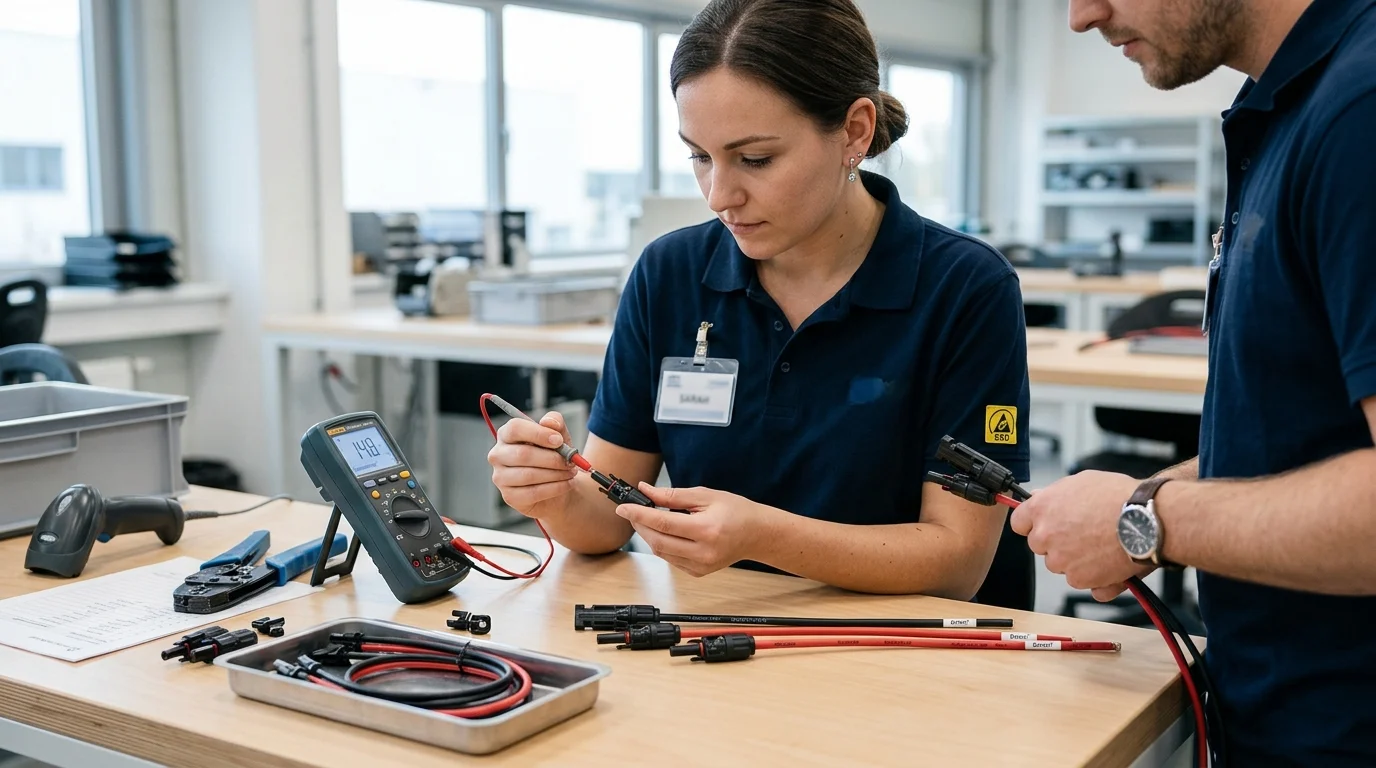
In Solar Connector production, quality assurance is not a box-checking exercise but a core control for electrical safety, system uptime, and warranty risk. Small defects in crimping, contact alignment, sealing, or material selection can escalate into resistance buildup, overheating, moisture ingress, and premature field failures across PV installations. This article outlines the protocols that reduce those risks at the manufacturing stage, from incoming material verification and dimensional checks to electrical, mechanical, and environmental testing. Readers will gain a practical view of how structured QA protects connector reliability, supports compliance, and helps manufacturers and project teams prevent costly failures before components reach the field.
Why Solar Connector Quality Assurance Matters

The reliability of a photovoltaic (PV) system depends heavily on its smallest components. Solar connectors serve as the critical junctions for direct current (DC) power transmission across commercial, industrial, and utility-scale solar arrays. Without stringent oversight, these components can become the weakest link in the energy generation chain, leading to severe safety hazards and substantial financial losses.
Key production and field failure risks
Production inconsistencies and environmental stresses present significant risks to PV installations. Common manufacturing defects include improper crimping, misaligned contact pins, and substandard housing materials that degrade rapidly under constant ultraviolet exposure. In the field, these flaws manifest as elevated contact resistance. Industry data indicates that up to 30% of catastrophic PV system failures, including localized electrical fires, originate from cross-mating or defective DC connectors where contact resistance exceeds the critical safety threshold of 0.5 milliohms.
Furthermore, thermal cycling between extreme temperatures, often ranging from -40°C to +85°C, exacerbates micro-cracks in substandard plastics. Water ingress due to failed O-ring seals can lead to ground faults and immediate inverter shutdowns. When connectors fail to maintain an IP68 rating in harsh weather, the resulting moisture accumulation accelerates galvanic corrosion, drastically reducing the system's operational lifespan and overall energy yield.
How to define effective quality assurance protocols
Establishing robust solar connector quality assurance protocols requires a comprehensive approach that encompasses the entire manufacturing lifecycle. Manufacturers must define clear, measurable targets, aiming for a defect rate of less than 100 parts per million (PPM) to ensure both commercial viability and field safety.
Effective protocols dictate specific testing intervals, acceptable tolerance limits, and standardized operating procedures for assembly line workers. By defining these parameters upfront, quality control teams can transition from reactive troubleshooting to proactive risk mitigation. This structured approach ensures that every production batch meets the necessary electrical, mechanical, and thermal baseline requirements before the components are authorized to leave the factory floor.
Quality Assurance Controls and Standards
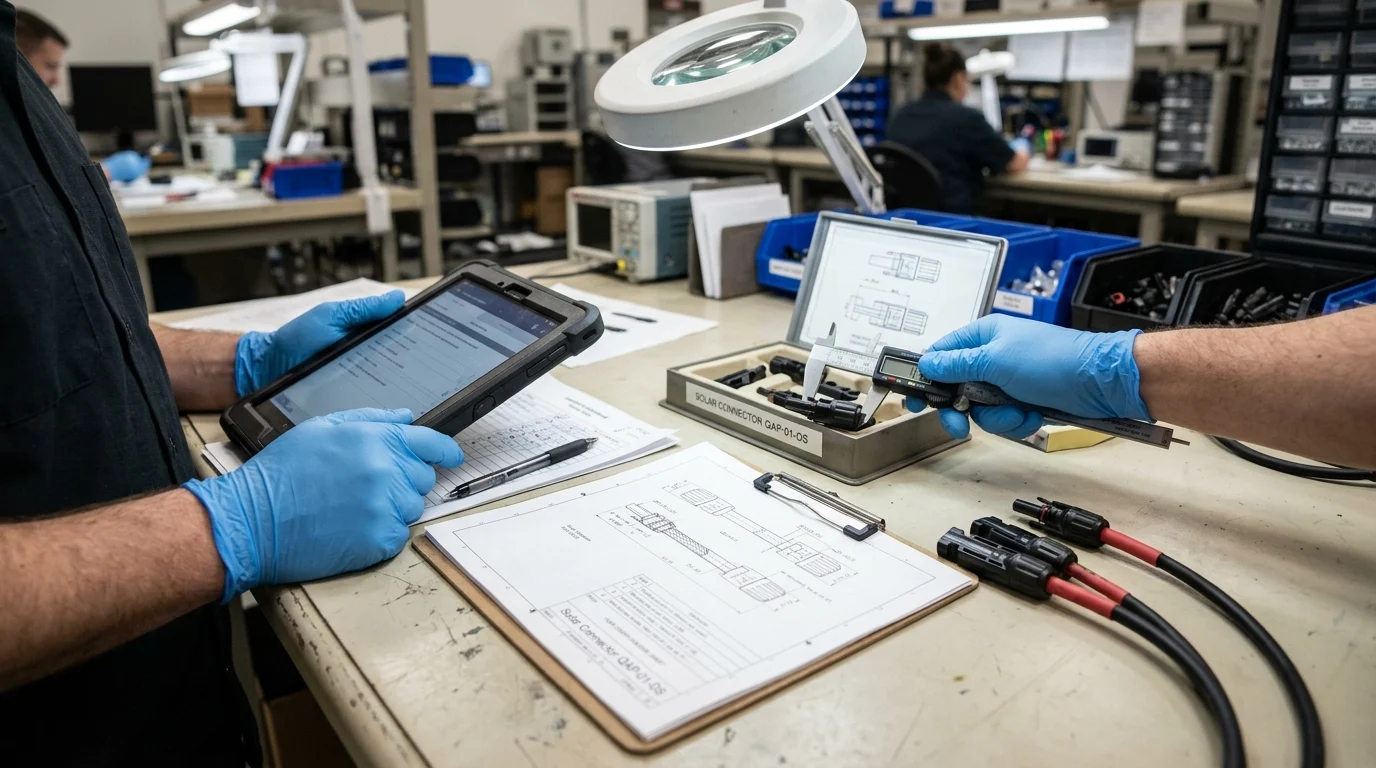
Transforming high-level quality goals into tangible results requires a structured framework of physical controls. This framework relies on a combination of advanced inspection technologies and strict adherence to globally recognized electrotechnical standards.
Incoming, in-process, and final inspection methods
Quality control operates across three primary stages: incoming, in-process, and final inspection. Incoming material checks verify the integrity of raw inputs, ensuring copper alloy pins achieve a minimum conductivity purity of 99% and polycarbonate housings meet specific flammability ratings, such as the UL94 V-0 standard.
In-process inspections utilize Automated Optical Inspection (AOI) to detect dimensional anomalies in real-time on the assembly line. During this phase, mechanical pull-force testing is critical; a standard 4mm² cross-section PV Cable must withstand a minimum pull-out force of 300 Newtons to confirm crimp integrity. Finally, rigorous electrical evaluations—including dielectric withstand voltage tests where assembled connectors are subjected to up to 6000V DC—verify insulation resistance and prevent high-voltage arcing in the field.
Standards, documentation, and comparison criteria
Compliance with international standards is non-negotiable for market entry and risk management. The two primary benchmarks governing Solar Connectors are IEC 62852 for global and European markets, and UL 6703 for North America. Quality assurance teams must maintain meticulous documentation, including material test reports (MTRs) and third-party laboratory certificates, to prove continuous compliance.
| Standard | Target Market | Max System Voltage | Minimum IP Rating | UV Exposure Testing |
|---|---|---|---|---|
| IEC 62852 | Global / EU | 1500V DC | IP67 / IP68 | 1000 hours |
| UL 6703 | North America | 1500V DC | IP67 | 720 hours |
| GB/T 33765 | China | 1500V DC | IP67 | 1000 hours |
Using these comparison criteria, procurement teams can evaluate whether a manufacturer's internal testing aligns with the specific environmental and regulatory demands of the installation site. Proper documentation ensures that all safety metrics are traceable and verifiable by independent auditors.
How Manufacturers and Buyers Should Implement QA
For both manufacturers producing the components and Engineering, Procurement, and Construction (EPC) firms purchasing them, implementing a cohesive quality assurance strategy is a collaborative effort. It requires aligning procurement practices with rigorous factory-level accountability.
Supplier qualification and batch traceability
Buyers must prioritize supplier qualification by conducting comprehensive audits of the manufacturer's Quality Management System (QMS), typically verifying active ISO 9001 certification. A critical component of this qualification is assessing the supplier's traceability infrastructure to ensure accountability across millions of produced units.
Effective traceability ensures that every connector can be linked back to its specific production shift, raw material batch, and machine operator. Leading manufacturers utilize laser-etched QR codes or unique serial numbers directly on the connector housing. Maintaining these batch records for a minimum of 25 years is essential, as this duration aligns with the standard performance warranty periods of modern photovoltaic modules, allowing for rapid root-cause analysis in the rare event of a field failure.
Balancing cost, lead time, and certification needs
Implementing comprehensive testing protocols introduces variables in production economics. Upgrading a manufacturing facility to meet top-tier inspection standards typically increases upfront production costs by 3% to 5%. Furthermore, integrating full-batch environmental and electrical stress testing can extend standard delivery lead times by 1 to 2 weeks.
However, manufacturers and buyers must balance these initial investments against long-term operational security. The slight increase in unit cost and lead time is negligible compared to the financial impact of a widespread system failure. Investing in certified, rigorously tested components reduces post-installation warranty claims by up to 80%, eliminates the exorbitant costs of emergency field replacements, and safeguards the overall return on investment for utility-scale solar assets over their multi-decade lifespans.
Key Takeaways
- The most important conclusions and rationale for solar connector quality assurance protocols
- Specs, compliance, and risk checks worth validating before you commit
- Practical next steps and caveats readers can apply immediately
Frequently Asked Questions
Why are QA protocols critical for solar connectors?
They reduce fire, arcing, and downtime risks by catching defects like poor crimping, bad seals, and high contact resistance before shipment.
What tests should a solar connector factory perform?
Use incoming material checks, AOI during assembly, pull-force testing, dielectric withstand testing up to 6000V DC, and final sealing verification.
Which standards should buyers verify for solar connectors?
Check IEC 62852 for global/EU projects, UL 6703 for North America, and confirm the product matches the site’s voltage and IP requirements.
What acceptance targets help mitigate connector failure risk?
Set a defect rate below 100 PPM, keep contact resistance under 0.5 milliohms, and require 4mm² cable pull-out strength of at least 300N.
What documents should EPCs request from connector suppliers?
Ask for material test reports, third-party lab certificates, standard compliance records, and batch traceability documents for every production lot.